






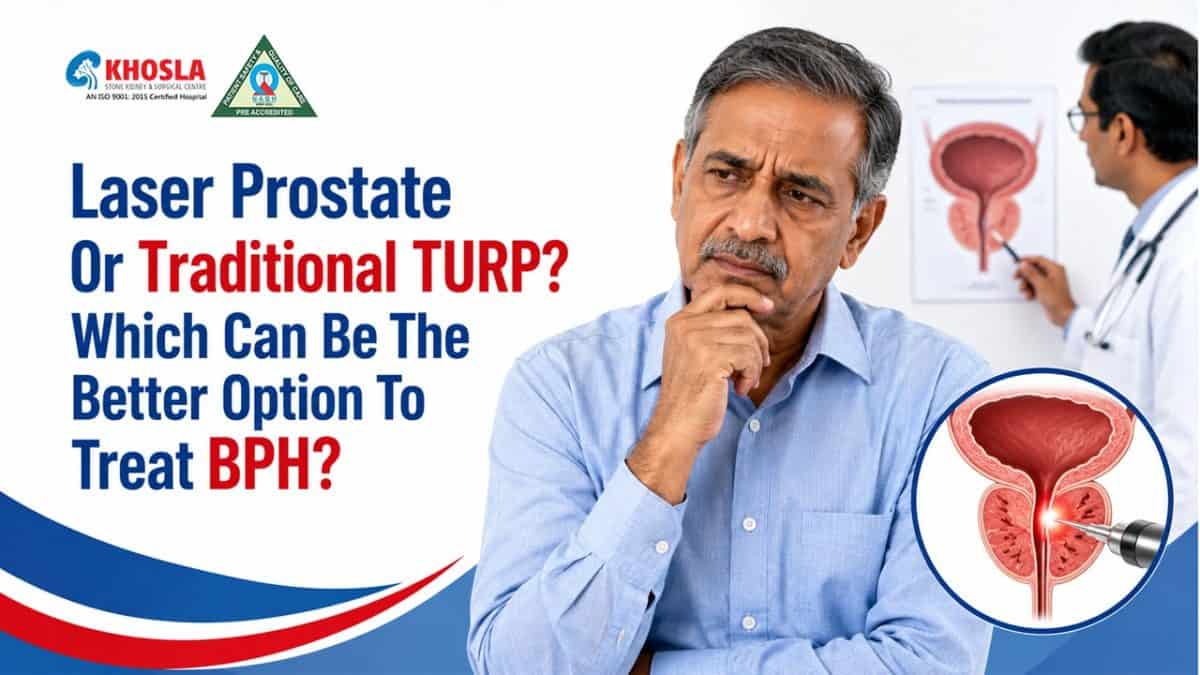

Benign prostatic hyperplasia, also known as a large prostate, affects a significant number of men according to their age. When it enlarges, the prostate gland encloses the urethra. It can block the flow of urine, causing symptoms such as frequent urination, weak urine stream and difficulty in cleaning the bladder. When the medications are no longer effective for this, then the best solution is surgery to improve the urinary symptoms. Two methods are used to remove enlarged prostate tissues: one is laser prostate surgery, and the other is traditional TURP. Both have differences in the use of technology for better outcomes and relief from symptoms in future. Laser prostate surgery is far better than the traditional TURP, as it reduces the loss of blood and hospital stays and is safer for those who are on blood thinners. By understanding the difference between the two methods, patients can choose the best for themselves on their own.
Let’s talk about traditional TURP
This method is considered the gold standard surgical treatment for BPH. The instrument, called a resectoscope, is used by surgeons to treat the prostate by inserting it into the urethra. The tissues that are responsible for blocking the flow of urine are removed. No need for external incisions since TURP is done through the urethra. In this, general anesthesia is given to patients, so it requires shorter hospital stays. In TURP, electrical energy is used to cut and remove the prostate tissues. It’s a well-established and proven method to relieve the symptoms and improve the flow of urine. A hospital stay is just for one to three days. This can result in more bleeding than the other advanced surgical methods.
Understand laser prostate surgery
Laser prostate is a new and advanced technique that uses high-energy laser beams for the removal of tissue of the enlarged prostate, blocking the urethra. There are various types of laser treatments, including green light laser treatment, HoLEP and other laser prostate surgeries. In this procedure, through an endoscope, laser energy is used for the removal of tissues and, at the same time, the process of sealing the blood vessels is done precisely. In laser surgeries, laser energy is used instead of electrical energy and causes less bleeding. It requires short hospital stays and is suitable for blood thinner patients, with a quick recovery. Search-based studies have given the result that laser surgeries require a short hospital stay, less bleeding, quick recovery and effective results.
How is laser surgery far better than traditional TURP?
It is widely used because it is a well-studied and time-tested procedure. It provides long-term and consistent relief from symptoms of a long prostate. Surgeons have experience to perform it well in almost all hospitals. For patients with moderate prostate enlargement, traditional TURP is the best solution for them.
Advantages and disadvantages of laser prostate surgery:
Advantages:
Laser treatments are better and more popular due to various reasons. In this, there is no risk of high bleeding and requires short hospital stays, fast recovery and a return to normal infections and less risk of infections. This is also suitable for patients with blood-thinning medications. It’s a preferred option for certain age groups.
Disadvantages:
As this advanced technique requires advanced equipment and techniques, which may not be available in all hospitals with highly experienced urologist surgeons, for better results, it is recommended to use this technique in hospitals with highly experienced urologist surgeons.
Both the surgical methods are effective for an enlarged prostate that can greatly improve the symptoms related to urinary and quality of life. The choice depends on various factors such as the size of the enlarged prostate, use of blood-thinning medications, age of the patient and overall health. A urologist with years of experience recommends the choice on the basis of all these factors. But overall, laser prostate surgery is best.
Conclusion
No doubt the traditional TURP is reliable and effective with successful outcomes, but it is not compared to laser prostate surgery. Laser prostate surgery is best because of minimal risk of bleeding and the use of laser energy instead of electrical energy for consistent and better results to get relief from symptoms of urinary-related problems and enlarged prostate. Dr. Rajesh Khosla, one of the experienced urologists of Khosla Stone Kidney and Surgical Centre, offers laser prostate surgery with advanced equipment and techniques.
FAQ’S
- Which treatment is best for patients with blood-thinning medications?
Laser prostate treatment is best for patients with blood-thinning medications, as in this case, there is no risk of excess bleeding. - Are these surgeries painful or painless?
Both surgeries are performed under local anesthesia so that patients should not feel any pain during surgery. Afterward, everything is normal. There is just a minimal burning sensation during urination, along with mild pain or cramping in the bladder.