

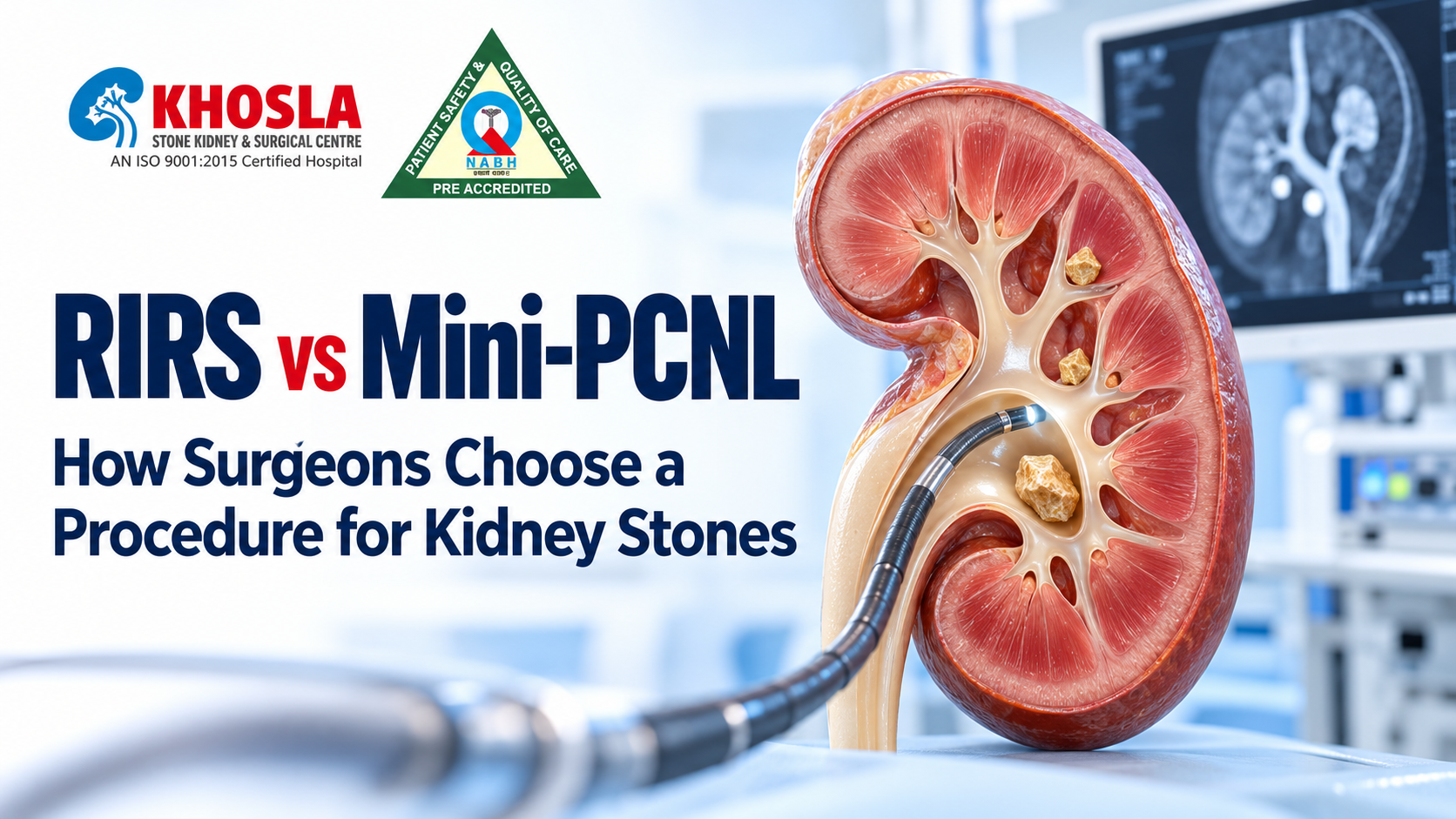
Kidney stones come in different sizes, locations, and numbers, which means patients receive different types of treatment. The surgeons will suggest one depending on the type of stones you have. There are two ways these kidney stones can be removed, which are RIRS and mini PCNL. If you are researching RIRS vs mini PCNL in Ludhiana, you have to compare these treatment surgeries with a urologist to make an accurate plan.
In this blog, you get to understand the key differences between RIRS vs mini PCNL for the treatment of kidney stones. Also, you will have a clear understanding of how surgeons consider stone size, location, number, and patient factors when selecting treatment options.
RIRS vs mini PCNL differences vary in terms of the recovery process and the way they are done.
How are they performed?
Refers to a highly minimally invasive endoscopic procedure used to treat kidney stones internally without making any cuts or incisions.
They are performed entirely through the urinary passage; a flexible scope will be inserted to enter the urethra, move through the bladder, and travel up into the kidney.
In this one, no incisions or cuts are made.
Mini-Percutaneous Nephrolithotomy
It is a type of minimally invasive surgery where the surgeon operates through a very small incision rather than a traditional, large open cut. It is used to remove large and complex stones using specialized tools to clear them all.
Performed directly through the back; a needle is guided via X-ray or ultrasound through the skin and muscle into the kidney.
Requires a single keyhole incision (about 5 to 8 mm) in the back.
RIRS Recovery
The patient can go home after 24 hours and is usually managed on the same day.
Quick recovery time; patients generally return to desk work and light daily routines within 2 to 3 days.
Mini-PCNL
You can stay in hospital for 1-3 days, being monitored by the surgeons to make sure the incisions are closed.
Patients may feel some muscular soreness because of the local wound pain at the puncture site on the back.
If you are dealing with a large kidney stone, analyzing a comparison between RIRS vs mini PCNL may help you prepare for the difference in recovery time.
Stone size
Doctors suggest retrograde intrarenal surgery when the stone is small or medium-sized, while mini percutaneous nephrolithotomy is performed for large stones over 2cm.
Stone location
dictates the choice of surgery, as lower-pole stones are often better cleared via Mini-PCNL's direct tract than RIRS's flexible scope angles.
Bleeding considerations
Because Mini PCNL requires creating an access tract into the kidney, some blood loss occurs.RIRS reaches the kidney through the urinary tract and generally avoids blood loss.
How do surgeons decide between Retrograde intrarenal surgery and Mini Percutaneous Nephrolithotomy?
Stone size and total stone burden
When the stone is small or medium, they will suggest RIRS, and when they are big over 2 cm, they will choose Mini-Percutaneous Nephrolithotomy because it clears large masses of stones in one session.
Bleeding risk and other conditions
This one passes through natural urinary pathways without external incisions; it is safer for patients with bleeding disorders and those unable to pause blood-thinning medications.
Patients preferences and recovery requirements
If a patient suggests a quick treatment because they want to go back to work, the surgeon will choose retrograde intrarenal surgery within 24 hours, and they will be discharged. They can go back to work after 2-3 days.
If a patient is comfortable with 1-3 days in hospital, they will decide on Mini-Percutaneous Nephrolithotomy to ensure complete clearance and manage external drainage tubes.
The main takeaway
There is no single best choice between RIRS and Mini-PCNL. Surgeons do not pick one because it is newer or cooler. Instead, they assess your kidney and choose the right treatment option for your specific stone. The most successful surgery is the one that sets you free from kidney stones with fewer complications.
If you have kidney stones that are affecting your overall health, you have to get treatment from Khosla Stone Kidney & Surgical Care. We provide treatment plans that set you free from either big or small stones in the kidneys. Dr Rajesh Khosla provides a wide range of services, diagnoses, treatments, and physical examinations to accurately diagnose kidney stones and related gallbladder conditions.